
























Narendra Modi Takes Oath for Third Consecutive Term as Prime Minister
Narendra Modi was sworn in for his third consecutive term as Prime Minister of India at a grand ceremony at Rashtrapati Bhavan. The event, attended by South Asian leaders, saw the induction of 30 Cabinet Ministers, 5 Ministers of State with Independent Charge, and 36 Ministers of State. Key figures like Rajnath Singh, Amit Shah, and Nitin Gadkari were among those who took the oath. The BJP, although falling short of an outright majority with 240 seats, formed the government with the support of NDA allies, totalling 293 seats. This marks Modi's historic third term, equaling Jawaharlal Nehru's record. The new government highlights the importance of coalition partners, reflecting a strategy of inclusive governance.

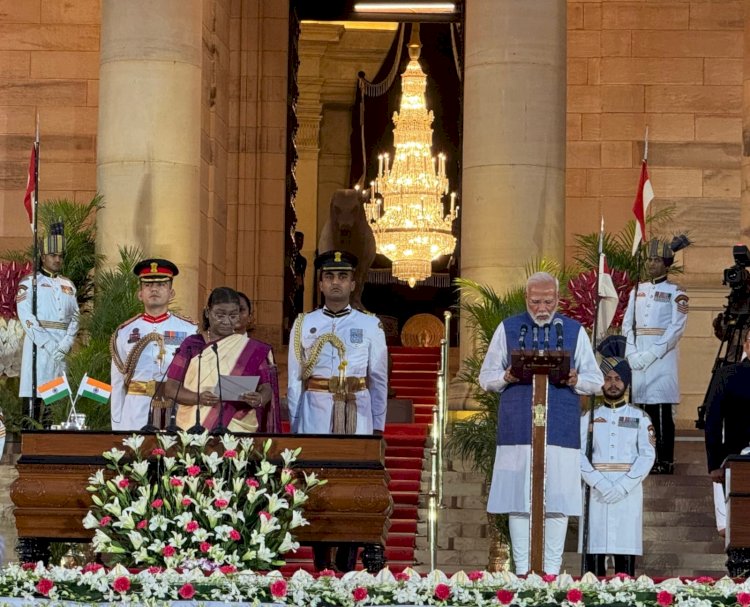
Narendra Modi took the oath of office for his third consecutive term as Prime Minister of India, in a grand ceremony held at the Rashtrapati Bhavan, presided over by President Droupadi Murmu. This historic event marked a continuation of Modi's leadership under the coalition banner of the National Democratic Alliance (NDA).
Ceremony Highlights
Narendra Modi has taken the oath of office for his third consecutive term as the Prime Minister of India. The ceremony, held at the Rashtrapati Bhavan, was presided over by President Droupadi Murmu, who administered the oath of office and secrecy to Mr Modi and other key members of his Cabinet. Honour guards lined the steps of the Rashtrapati Bhavan, where thousands gathered to watch PM Modi, dressed in a white kurta and blue waistcoat, take the oath. This significant event marks Mr Modi's continuation at the helm of the Indian government after two full terms in which his party, the Bharatiya Janata Party (BJP), held a majority.
Cabinet Ministers
Alongside Mr Modi, 30 Cabinet Ministers were sworn in on Sunday. Prominent figures such as Rajnath Singh, Amit Shah, and Nitin Gadkari were among those who took the oath. The complete list of Cabinet Ministers includes:
- Rajnath Singh
- Amit Shah
- Nitin Gadkari
- JP Nadda
- Shivraj Singh Chouhan
- Nirmala Sitharaman
- S. Jaishankar
- Manohar Lal Khattar
- HD Kumaraswamy
- Piyush Goyal
- Dharmendra Pradhan
- Jitan Ram Manjhi
- Rajiv Ranjan Singh alias Lalan Singh
- Sarbananda Sonowal
- Dr. Virendra Kumar
- Kinjarapu Ram Mohan Naidu
- Pralhad Joshi
- Jual Oram
- Giriraj Singh
- Ashwini Vaishnaw
- Jyotiraditya Scindia
- Bhupender Yadav
- Gajendra Singh Shekhawat
- Annapurna Devi
- Kiren Rijiju
- Hardeep Singh Puri
- Mansukh Mandaviya
- G. Kishan Reddy
- Chirag Paswan
- C.R. Patil
Ministers of State with Independent Charge
The new team also includes five Ministers of State with Independent Charge:
- Rao Inderjit Singh
- Jitendra Singh
- Arjun Ram Meghwal
- Prataprao Ganpatrao Jadhav
- Jayant Chaudhary
Ministers of State
Additionally, 36 Ministers of State were sworn in. The list includes:
- Jitin Prasada
- Shripad Naik
- Pankaj Chaudhary
- Krishan Pal Gurjar
- Ramdas Athawale
- Ram Nath Thakur
- Nityanand Rai
- Anupriya Patel
- V. Somanna
- Dr. Chandra Sekhar Pemmasani
- S.P. Singh Baghel
- Shobha Karandlaje
- Kirti Vardhan Singh
- B.L. Verma
- Shantanu Thakur
- Suresh Gopi
- L. Murugan
- Ajay Tamta
- Bandi Sanjay Kumar
- Kamlesh Paswan
- Bhagirath Chaudhary
- Satish Chandra Dubey
- Sanjay Seth
- Ravneet Singh Bittu
- Durga Das Uikey
- Raksha Khadse
- Sukanta Majumdar
- Savitri Thakur
- Tokhan Sahu
- Rajbhushan Chaudhary
- Bhupathiraju Srinivasa Varma
- Harsh Malhotra
- Nimuben Jayantibhai Bambhaniya
- Murlidhar Mohol
- George Kurian
- Pabitra Margherita
Coalition Government
Mr. Modi's third term is noteworthy as it comes under the banner of a coalition government. The BJP, while still the dominant force within the coalition, did not secure an outright majority on its own in the latest election. The BJP won 240 seats, short of the 272 required for a majority, compared to the 286 seats secured by the National Democratic Alliance (NDA) as a whole. Allies helped the NDA cross the majority mark, achieving a total of 293 seats.
Induction of Coalition Partners
The swearing-in ceremony also highlighted the rewarding of coalition partners within the NDA. Notable inclusions were MPs from the Telugu Desam Party (TDP) and the BJP in Andhra Pradesh, where the NDA claimed a significant victory by winning 21 out of 25 Lok Sabha seats. Key figures such as TDP’s Ram Mohan Naidu and Pemmasani Chandrashekhar, JD(S)’s H.D. Kumaraswamy, and BJP’s Sarbananda Sonowal were inducted into the Cabinet, reflecting the coalition's inclusive strategy.
Historical Context
At 73, Narendra Modi's third consecutive term equals the record set by India’s first Prime Minister, Jawaharlal Nehru, who won in the 1952, 1957, and 1962 general elections. This milestone underlines Mr. Modi's enduring political influence and leadership within Indian politics.
International Attendance
The swearing-in ceremony was attended by leaders from seven countries within South Asia and the Indian Ocean region, including Bangladesh, the Maldives, and Sri Lanka. Notably, neighbouring rivals China and Pakistan did not send top leaders to the event. This attendance reflects the broader geopolitical importance of India and its leadership within the region
The induction of Narendra Modi and his Cabinet signifies a new chapter in India's political landscape, emphasizing the importance of coalition politics and inclusive governance. With a blend of seasoned leaders and coalition partners, the Modi government is poised to navigate the challenges and opportunities ahead.